Tubes, Sticks or Compacts: Choosing a Format for a Small Bag
Tubes, sticks or compacts: choosing a format for a small bag helps you avoid awkward shapes, messy access and wasted space with a better fit.
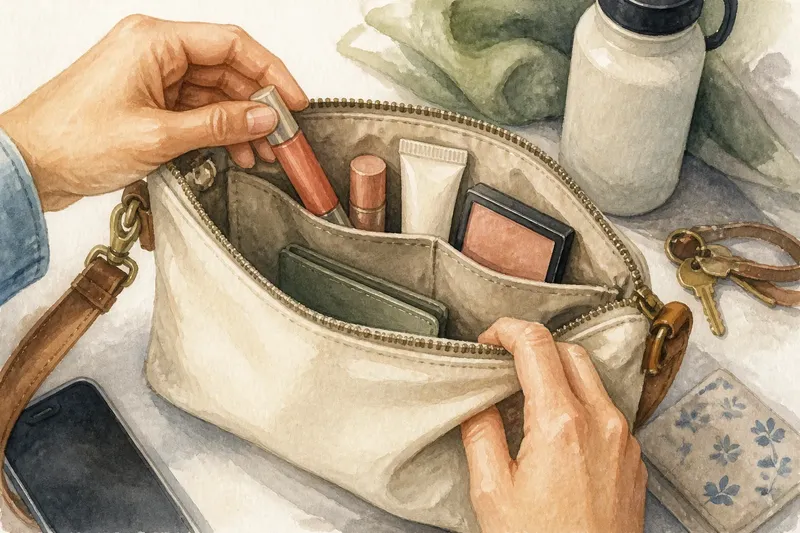
Your lip color fits neatly beside your keys, but the sunscreen tube bulges across the zipper and the compact catches on the lining. Tubes, sticks or compacts can all work in a small bag; the right choice depends on the shape of the pocket, how you reach for the product and what happens when you carry it around.
Think of the format as a packing decision, not a verdict on the formula. A slim tube may tuck into a narrow seam, while a stick can be easier to handle without a separate applicator. A compact may keep a powder pan protected, but its flat shape can claim more width than its contents suggest. When something feels inconvenient, identify the specific friction before replacing it.
Why does a product keep catching on the zipper?
A rigid item placed across a narrow pocket can sit directly in the zipper’s path. Square-edged compacts, wide caps and tubes with a stiff shoulder may snag even when the bag has enough room overall. The issue is often orientation, not capacity.
Try turning the item so its narrow side faces the zipper, or move it to a pocket with a straight opening. Keep hard-edged packaging away from loose fabric and delicate items that can catch against corners. If the bag’s opening curves sharply, a short, rounded container may be easier to remove than a long case that has to bend through the gap.
Say you carry a small canvas crossbody with a narrow inner pocket and a rectangular blush compact. If the compact catches when you pull it out, imagine turning it lengthwise and placing it behind a flat card sleeve; the expected observable result is a clearer path through the pocket, with less fabric snagging. If that orientation still blocks the zipper, reserve the pocket for a slimmer item rather than forcing the fit.
Try changing the angle before changing the product.
Why does a tube feel messy to use on the move?
Tubes often have a flexible body and a cap that comes off separately. That makes them adaptable to narrow spaces, but the open tube can be awkward when one hand is holding a phone or a transit pass. A soft tube may also shift shape as other objects press against it, making the opening less predictable.
Check where the cap goes while you apply the product. If it tends to roll under a seat or disappear into a crowded pocket, a flip-top closure may be more manageable than a separate screw cap. If the product needs to be squeezed, look for a spot where you can pause and use both hands instead of trying to control the tube while walking.
To keep residue from transferring, close the cap fully and store the tube in a small washable pouch if its exterior is prone to smearing. Avoid placing it beside fabric that you would not want to spot-clean. For a tube that is already difficult to control, keep it upright when practical and use a stable surface rather than squeezing while the opening faces down over your bag.
A tube is most convenient when you have a moment to open, dispense and close it deliberately.
Why does a stick become awkward in a tight pouch?
Sticks are usually self-contained, which can make them quick to grasp and apply. Their length, however, may be a poor match for a shallow pouch or a pocket with a curved base. A stick can sit diagonally, press against the zipper or disappear beneath other items even though it takes up little space in cross-section.
Compare the stick’s full length with the usable depth of the pocket, including the space taken up by seams and a zipper flap. If the package has a twist-up base, check that it cannot turn easily in the bag. Keep the cap secure and avoid storing the product where the lid is likely to be knocked loose by keys or a metal clip.
For a narrow bag, place a long stick along an edge rather than across the center, where it can divide the available space. If you use several, arrange them together in a slim sleeve so they are easier to locate and less likely to roll into the corners. A shorter stick may fit better, but only if its grip remains comfortable for you.
Choose a stick for the pocket it can lie in, not the space it appears to occupy on a counter.
Why does a compact take over a small bag?
A compact is flat, but flat does not always mean space-efficient. Its width and depth can prevent other items from sitting beside it, while a hinged lid needs room to open. It may be convenient for keeping a pressed product enclosed, yet inconvenient if you have to remove several belongings just to reach it.
Look at the compact’s footprint against the bottom of the bag. If it covers most of the base, decide whether that broad, stable shape is worth giving it a dedicated spot. A compact with a secure closure can ride in a sleeve or a flat pocket; one that opens easily may need separation from objects that press on the lid.
Think about where you will use it, too. If you need a mirror or a protected pan, the case may offer useful features beyond holding the product. If you only need the color and rarely use the mirror, a different format may suit the carry space better. Do not assume that moving a pan into a smaller case is suitable for every product; use packaging intended for that product and follow its directions.
Keep a compact flat, and make sure its opening is not pinned shut by the bag’s contents.
Which format fits your bag’s shape and your access needs?
Which format suits a narrow side pocket?
A slim tube or a narrow stick often fits a long pocket better than a broad compact. Check that the cap or base does not catch at the opening, and leave enough room to remove the item without pulling the pocket inside out.
Which format works when you need one-handed access?
A stick or a tube with a flip-top can be simpler to hold than a compact that needs to be opened and set down. The best choice still depends on the product’s application and your grip, so try the opening action at home before carrying it.
Which format is easiest to protect from leaks or smears?
A closed stick or a compact with a secure latch may keep its contents contained, while a tube needs a cap that stays firmly in place. Check the package for wear and keep any formula that can transfer away from pale fabric.
Which format works best in a bag with a curved base?
A short, rounded tube may follow the curve more easily than a rigid compact. A longer stick can still work if it lies along the side, but avoid packing it diagonally across the area where other items need to settle.
What should you check before changing formats?
Before buying another package, recreate the carry problem at home. Put the bag on a table, load the items you actually carry, and notice which item blocks the opening, gets buried or needs two hands to use. Then test one change at a time: reposition the current product, move it to another pocket or add a small washable pouch.
- Opening: Can you reach the product without pulling the zipper around a hard corner?
- Depth: Does the package sit inside the pocket, or press against the closure?
- Grip: Can you hold the package and operate its cap or hinge comfortably?
- Containment: Does the closure stay shut when the bag shifts?
- Neighboring items: Could keys, clips or fabric rub against the lid, cap or product surface?
- Use location: Will you have a stable place to apply the product, or do you need a simpler opening action?
If a package is damaged, its closure no longer works properly or its label gives specific storage directions, follow the manufacturer’s instructions. For a product that repeatedly marks the bag, separate it from fabric and reconsider whether that particular formula belongs in the same pocket.
When tubes, sticks or compacts are competing for room, choose by the specific obstacle: a tube for a narrow slot, a stick for direct access, or a compact when a flat protective case earns its space. Tubes, sticks or compacts for a small bag are easiest to choose when you test the package in the pocket you will actually use, with the other items already in place. A small adjustment in orientation or location may solve the problem without adding another product.